AI transformation
AI transformation that works in processes and does not end in pilot slides
AI Transformation is not a tool rollout or a hackathon program. It is a targeted restructuring of decisions, processes and responsibility so that knowledge becomes effective more quickly. Kaufman AIS accompanies companies from strategic prioritization to building a resilient AI platform to operational anchoring in the specialist departments. The focus is on measurable business impact, clean governance and an operating model that works even under regulation, legacy landscapes and scarce teams.
Why many AI programs fail to transform
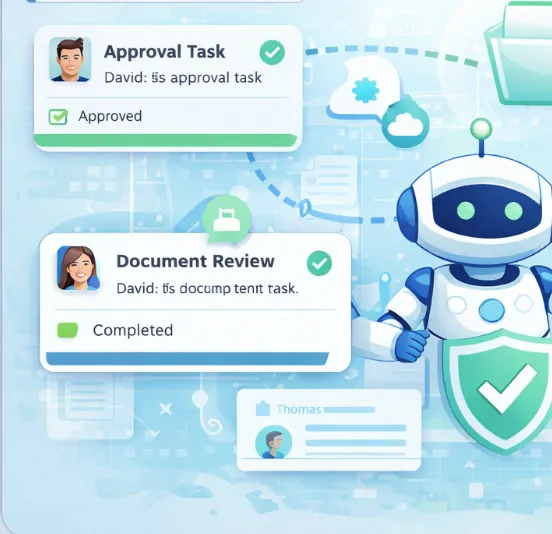
There are initial AI successes in almost every company today. A team tests a copilot, a department automates a report, an innovation unit starts a prototype. Nevertheless, the overall effect often remains limited. The reason is rarely a lack of technology. The problem is the gap between individual solutions and corporate operations.
- Use cases are prioritized based on visibility rather than value lever. The result is demos with no contribution margin.
- Data, processes and responsibilities are not viewed together. This creates solutions that are not viable in day-to-day business.
- Compliance is integrated too late. Security and data protection issues stop projects shortly before they go live.
- Departments see AI as an additional task instead of as a lever for better decisions and shorter lead times.
- Technology decisions are made in isolation. Platforms and models later do not fit the IT strategy or regulatory requirements.
- There is a lack of clear roles for product responsibility, operations and quality assurance. After the pilot, no one knows who scales and who pays.
AI transformation therefore does not begin with a model question, but with the question of where the company is losing time, margin or quality today and which AI-capable processes have the greatest leverage there.
The Kaufman AIS Transformation Method
We combine strategy work with operational implementation. Instead of roadmaps without any reference to reality, we deliver a transformation program that leverages concrete business levers and at the same time creates the technological and organizational basis for scaling.
- Value-driven start with a clear leverage map of processes, decision points and knowledge bottlenecks.
- Prioritized use case pipeline with effort-benefit assessment, risk assessment and dependencies on data and systems.
- Target image for architecture, governance and roles, tailored to your regulatory and IT landscape.
- Waves of implementation with clear 90-day goals so that progress remains visible and controllable.
- Building an AI operating model that combines product responsibility, data quality, monitoring and continuous improvement.
- Enablement of the departments so that AI does not remain as a foreign body, but is anchored in leadership, planning and day-to-day business.
What results a structured AI transformation delivers
A good transformation not only reduces effort, but also changes the quality of decisions. Teams find relevant information faster, routine work is automated and managers control based on consistent signals instead of manual reports.
Technological foundation for a resilient transformation
Transformation requires a technical backbone that fits your goals. We are not building an oversized platform, but rather a modular system that starts with the most important value streams and is expanded step by step. We combine RAG systems, integration layers, workflow orchestration and model-agnostic governance.
Process and Value Mapping
We analyze end-to-end processes including media disruptions, releases, bottleneck roles and information losses. From this map we derive the use cases with the highest degree of implementation and a clear impact on results.
Data and knowledge layer
Corporate knowledge from DMS, ERP, CRM, ticketing and collaboration systems is connected via connectors and brought together in a controlled knowledge layer. Rights and roles from source systems are retained.
AI services and agent logic
Depending on the application, we use assistance patterns, digital assistants or AI agents. Models are selected based on data protection, cost profile, quality and response latency.
Workflow integration
AI is embedded where work takes place anyway, in service processes, sales processes, operations or management routines. This does not create shadow processes, but rather real productivity gains.
Governance, monitoring, FinOps
We implement quality metrics, logging, model versioning and cost control. This creates transparency about the benefits and operating costs of each AI function.
Security and operating model
The architecture can be operated in European cloud or sovereign AI. This means the transformation remains compatible with regulatory requirements and internal security standards.
Typical transformation levers in specialist areas
AI transformation has an impact when it is built along concrete value streams. We see the following patterns particularly frequently in medium-sized and larger organizations.
Sales and quotation processes

Offer modules, technical specifications and pricing logic are prepared in a context-sensitive manner. Teams create qualified offers faster and reduce rework through consistent content.
Service and Operations
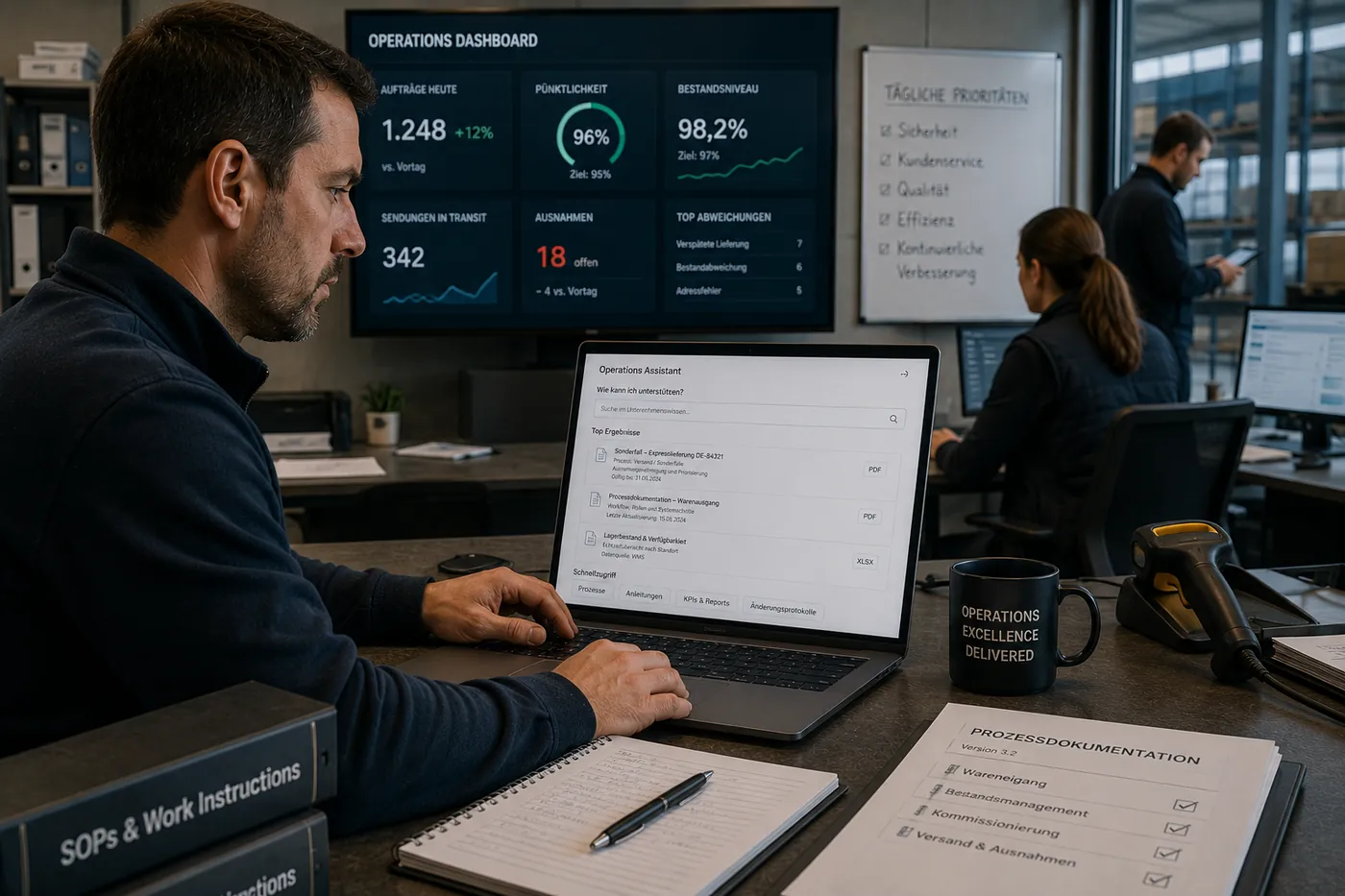
Tickets, incident images and knowledge database content are automatically brought together. Employees receive prioritized recommendations for action and reduce resolution times.
Management reporting

Reports are no longer created exclusively manually. AI prepares metrics, comments and risks, while executives retain content control and approval.
Purchasing and supplier management

Contract knowledge, supplier histories and risk indicators are bundled. Decisions regarding renegotiation, escalation or replacement suppliers are made earlier and more informed.
HR and internal services
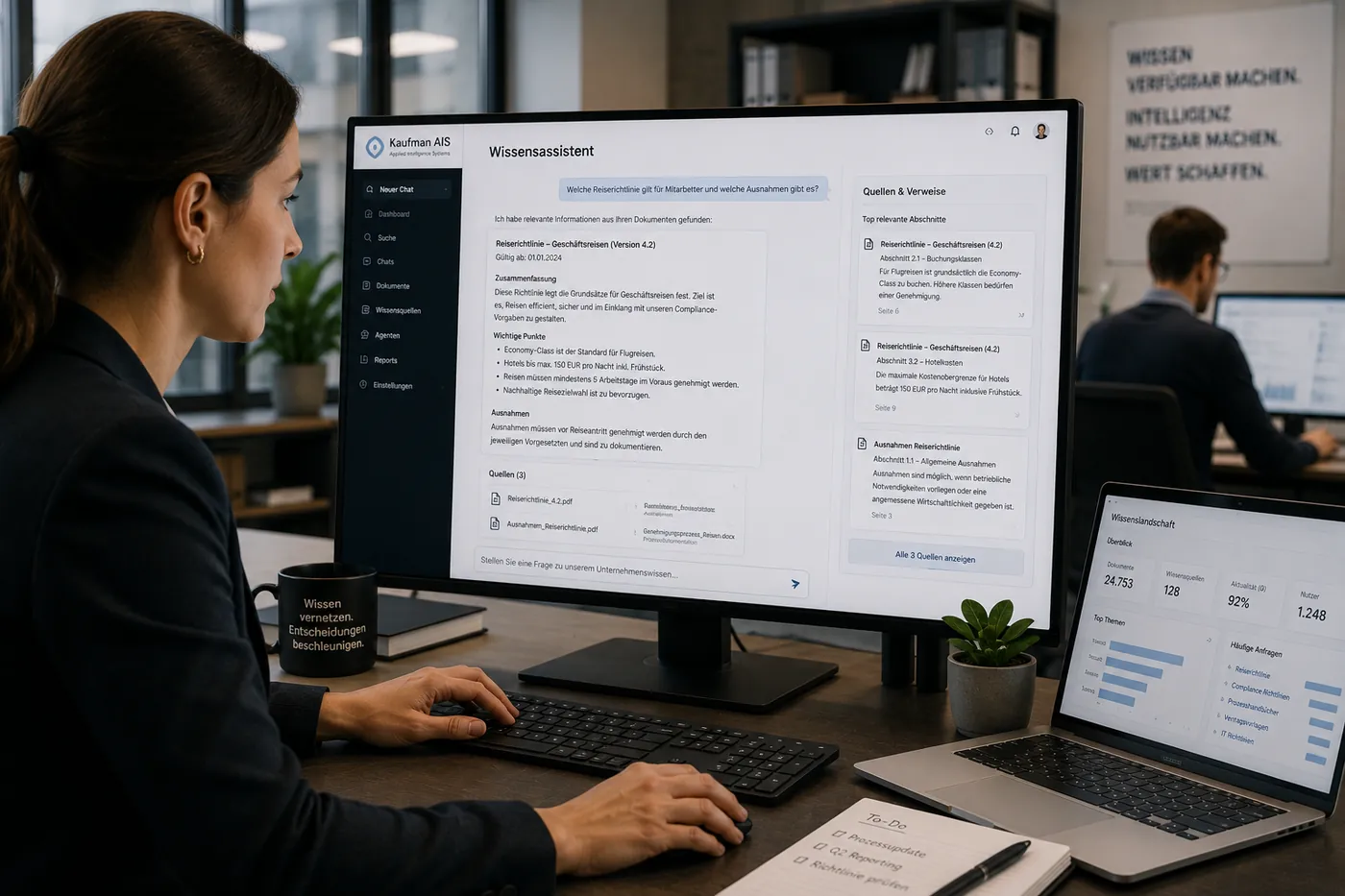
Internal assistants provide relief with standard inquiries about guidelines, onboarding and process paths. This reduces throughput times in cross-sectional functions.
Compliance and Regulation

Guidelines, specifications and evidence can be found in a structured manner. Audits receive reliable evidence more quickly and operational teams work more reliably according to the specifications.
AI transformation compared to typical alternatives
Companies often start with isolated pilot projects or a pure tool focus. This can be visible in the short term, but rarely has a lasting effect. The comparison shows why a structured transformation model creates more leverage.
Comparison of approaches for implementation capability
| criterion | Kaufman AIS | Tool rollout without an operating model | Pilot focus without scaling | Pure IT transformation |
|---|---|---|---|---|
| Prioritize based on business value | Yes, along the lever map and impact measurement | Limited, often oriented towards license usage | Rare, focus on feasibility | Partly, more technical than business |
| Anchoring in the department | Yes, with clear roles and process connection | Low, use remains optional | Occasionally, often only test users | Weak, focus on platform operations |
| Scalability across multiple use cases | Yes, modular target architecture | Limited by tool limits | No, because it's a single pilot | Yes, but often without quick proof of value |
| Controllability of benefits and costs | Yes, KPI and FinOps model | Restricted | Hardly there | Above all, costs, less benefits |
| Acceptance of data protection and auditing | High, compliance by design | Project dependent | Low on scaling | Means, depends on process integration |
Results profile after 12 months
| criterion | Kaufman AIS | Tool rollout without an operating model | Pilot focus without scaling |
|---|---|---|---|
| Productive AI workflows in core processes | Several, with measurable effects | Few | Individual tests |
| Demonstrable impact on margin and time | Partially | Rarely | |
| Reusable architecture | Tool bound | No | |
| Organizational learning curve | High and structured | Inconsistent | Small amount |
Governance, risk and security in transformation
The deeper AI intervenes in processes, the more important clear guardrails become. We do not integrate governance as a control authority against the departments, but as an operating principle for reliable scaling.
- Role and rights management along existing IAM structures, including logging of access and response context.
- Data classification for sensitive content so that model usage and storage locations are controlled based on rules.
- Prompt, model and policy governance with approval processes for productive changes.
- Quality assurance via test sets, release criteria and continuous monitoring of response quality and error rates.
- Comprehensible documentation for data protection, auditing and the works council.
- Operating models in EU infrastructure or on-premise for sensitive application areas.
Frequently asked questions about AI transformation
What distinguishes AI Transformation from individual AI projects?
Individual projects usually solve a local problem. AI Transformation, on the other hand, builds a company-wide impact model with prioritization, architecture, governance and organizational anchoring. This means that results do not remain isolated, but rather scale across multiple areas.
How quickly will we see the first results?
Typically within the first 8 to 12 weeks, provided there is a prioritized use case with sufficient data. We work in clear implementation waves so that early go-live is possible and long-term platform capability is created at the same time.
Does the entire IT landscape have to be modernized first?
No. We build integration capability in your existing landscape. The goal is not a big bang conversion, but rather a gradual build-up with clear levers. Legacy systems can be connected if interfaces, data quality and rights concepts are clearly modeled.
What role do departments play in the program?
A central role. Departments define priorities, test usability and bear operational responsibility for impact. Without this anchoring, AI remains a technical topic. Our method therefore relies on joint teams with specialist responsibility, IT and governance.
How do we measure success?
We define specific target metrics for each use case, for example throughput time, first solution rate, offer speed, error rate or processing costs. In addition, we record acceptance, intensity of use and qualitative effects on decision quality.
What happens when there are regulatory requirements?
We integrate data protection, information security and auditing into the design early on. This reduces late friction and creates resilient release paths. Depending on the industry, we take additional requirements such as DORA, ISO 27001, TISAX or industry-specific documentation requirements into account.
Can existing tools continue to be used?
Yes. We work model and tool diagnostically. Existing platforms are used where they have an impact. At the same time, we create an architecture that allows changes and expansions so that you don't end up with inflexible dependencies.
How big does the central AI team have to be?
That depends on complexity and ambition. Many companies start with a lean core team of product responsibility, data expertise and platform operations. What matters is less team size than clear responsibility and a functioning operating model.
How do we avoid shadow AI in the departments?
Through clear guidelines, simple usage offers and quick productive alternatives. When teams have access to secure, high-performance solutions, the incentive for uncontrolled individual solutions is significantly reduced.
Is AI Transformation only relevant for large corporations?
No. Medium-sized companies in particular benefit greatly because they can create an impact more quickly with focused prioritization. It is important to structure the entry using fewer, clear levers and not to open too many construction sites at the same time.
Assess AI opportunity in 3 minutes
A short check of systems, friction points, and goals shows where enterprise AI can create measurable impact first.
Start AI transformation with a clear business case
In the initial consultation, we analyze your most important value streams, identify the most effective AI levers and outline a reliable approach for the first 90 days. You receive a prioritized roadmap, an architectural target image and a realistic implementation plan for your company.
Contact
Tell us about a process you want to improve. We will map its data and systems, then discuss a secure first step for AI.