Digital assistants
Digital assistants that take on real work in the company
Digital assistants are more than just a chat window over documents. Properly built, they take on recurring tasks in service, sales, operations and internal processes, with access to current company knowledge, clear role rights and traceable sources. Kaufman AIS develops assistance systems that are productively integrated into existing work processes and thereby measurably save time, ensure quality and relieve teams of repetitive knowledge work.
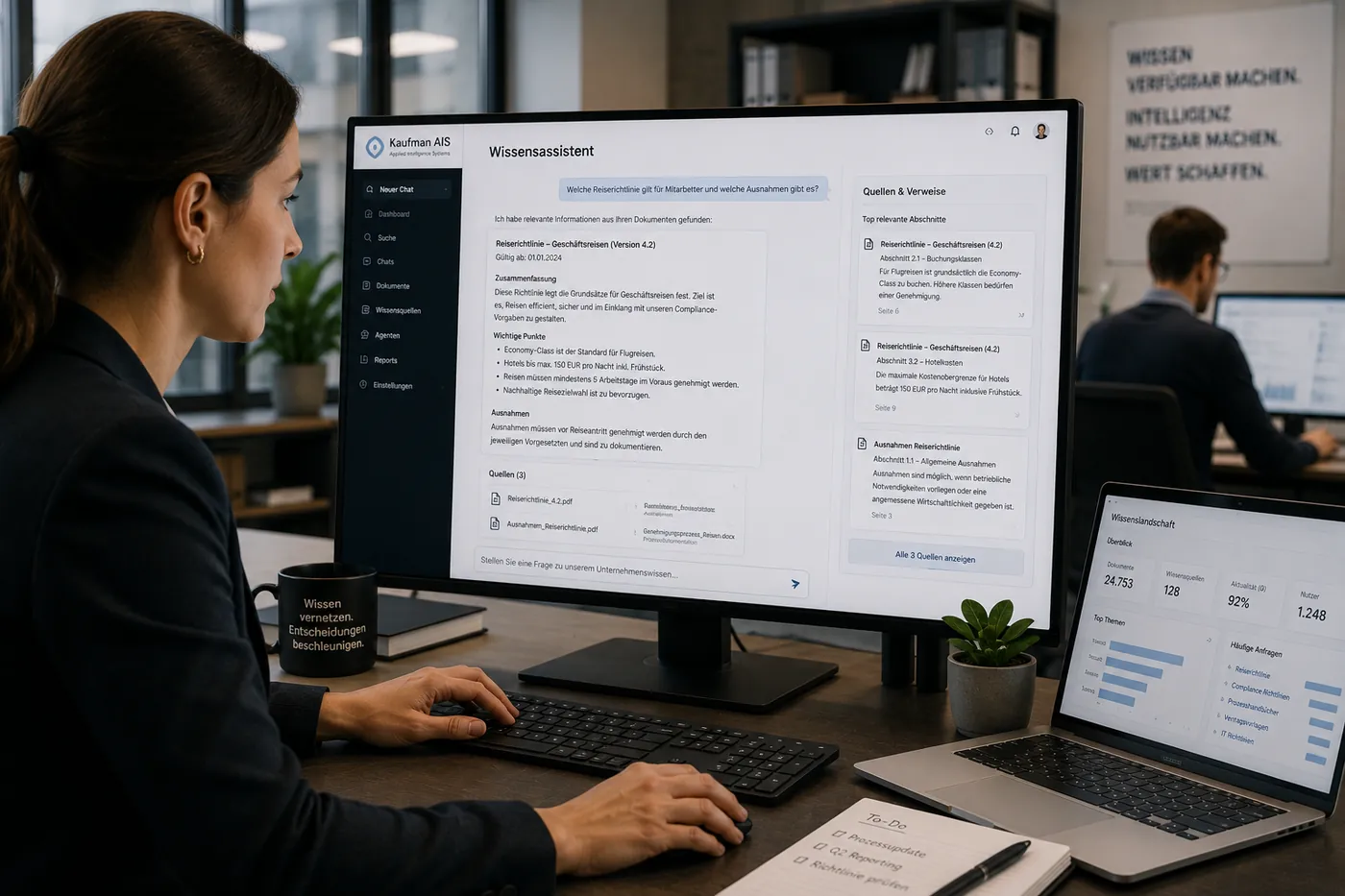
Why standard chatbots are often not enough in companies
Many organizations start with generic AI tools expecting immediate productivity gains. In practice, the benefits often remain limited because assistance systems are introduced without reference to the process, rights context and knowledge architecture. Then they answer simple questions, but do not create any stable added value in everyday operations.
- Answers are based on general model knowledge rather than your verified company content.
- Technical statements are not backed up by sources, which means there is a lack of trust in critical situations.
- Assistants are not embedded in real workflows and create additional work instead of relief.
- Roles and permissions are inadequately considered, creating security and compliance risks.
- Without clear responsibilities, there is no operating model for quality, further development and monitoring.
- Teams initially use the solution intensively, but quickly fall back to manual processes when results are inconsistent.
An effective digital assistant is therefore not created through prompt tuning alone, but through the combination of knowledge base, process integration, governance and continuous improvement.
How Kaufman AIS builds digital assistants
We develop assistance systems as productive business applications. This means that each assistant has a clear area of responsibility, defined interfaces, a regulated rights model and reliable quality metrics. The goal is not to answer everything, but to reliably automate the right tasks.
- Focus on specific assistance tasks with high volume and clear business impact.
- Connection to company knowledge via RAG systems and structured data sources.
- Sourced answers with transparent references for traceability and trust.
- Role and rights transfer from existing systems so that every response only uses authorized content.
- Integration into existing tools, such as ticketing, CRM, intranet or collaboration platforms.
- Ongoing operations with monitoring, feedback loops and further development of content by specialist departments.
What effect digital assistants have in everyday life
If digital assistants are anchored correctly, they have a direct impact on throughput times, response quality and employee relief. The effect is particularly strong where teams process many recurring knowledge and decision-making tasks every day.
Architecture of digital assistants in companies
Our assistant architecture combines language models, company knowledge and process logic into a controlled overall system. The structure is modular so that individual assistants can start quickly and later be integrated into a more comprehensive Enterprise Knowledge System.
Task model and intent boundaries
Each assistant has a clearly defined purpose, for example service support, offer preparation or internal policy information. This demarcation prevents uncontrolled responses outside the intended context.
Knowledge connection via retrieval
Documents, FAQs, process descriptions, CRM information and other sources are indexed and linked using semantic search. The assistant answers questions based on current content instead of outdated assumptions.
Roles, rights and client context
Permissions from source systems are enforced down to the response level. Employees only see content for which they are authorized, even if the same question is asked by multiple roles.
Response logic and guardrails
Prompts, policies and model parameters are managed centrally. The assistant identifies uncertainty, refers to sources and escalates in the event of a lack of evidence instead of providing free speculation.
Process integration and actions
Assistants not only deliver text, but also start defined subsequent steps such as ticket classification, document preparation or routing to the responsible teams.
Monitoring and learning loops
Usage, response quality and expert feedback are systematically evaluated. This means that the assistant continuously improves based on real requests instead of theoretical test cases.
High-leverage digital assistant deployment patterns
We implement assistance functions where recurring knowledge work increases lead times or causes errors. Scenarios with a high volume of inquiries and clear decision logic are particularly effective.
Service desk and support

Wizards suggest solution steps based on historical tickets, product documentation and internal guidelines. This speeds up initial reactions and improves the solution rate.
Sales assistance

For quotation requests, the assistant provides product arguments, references, pricing logic and risks from the knowledge base. This means sales teams work faster and more consistently.
Internal knowledge assistant
Employees answer questions about processes, policies and system paths in seconds. This reduces dependencies on individuals and relieves pressure on cross-sectional areas.
Compliance assistance

Assistants support the classification of regulatory questions based on stored specifications and provide comprehensible sources for audits and approvals.
Operations and scheduling
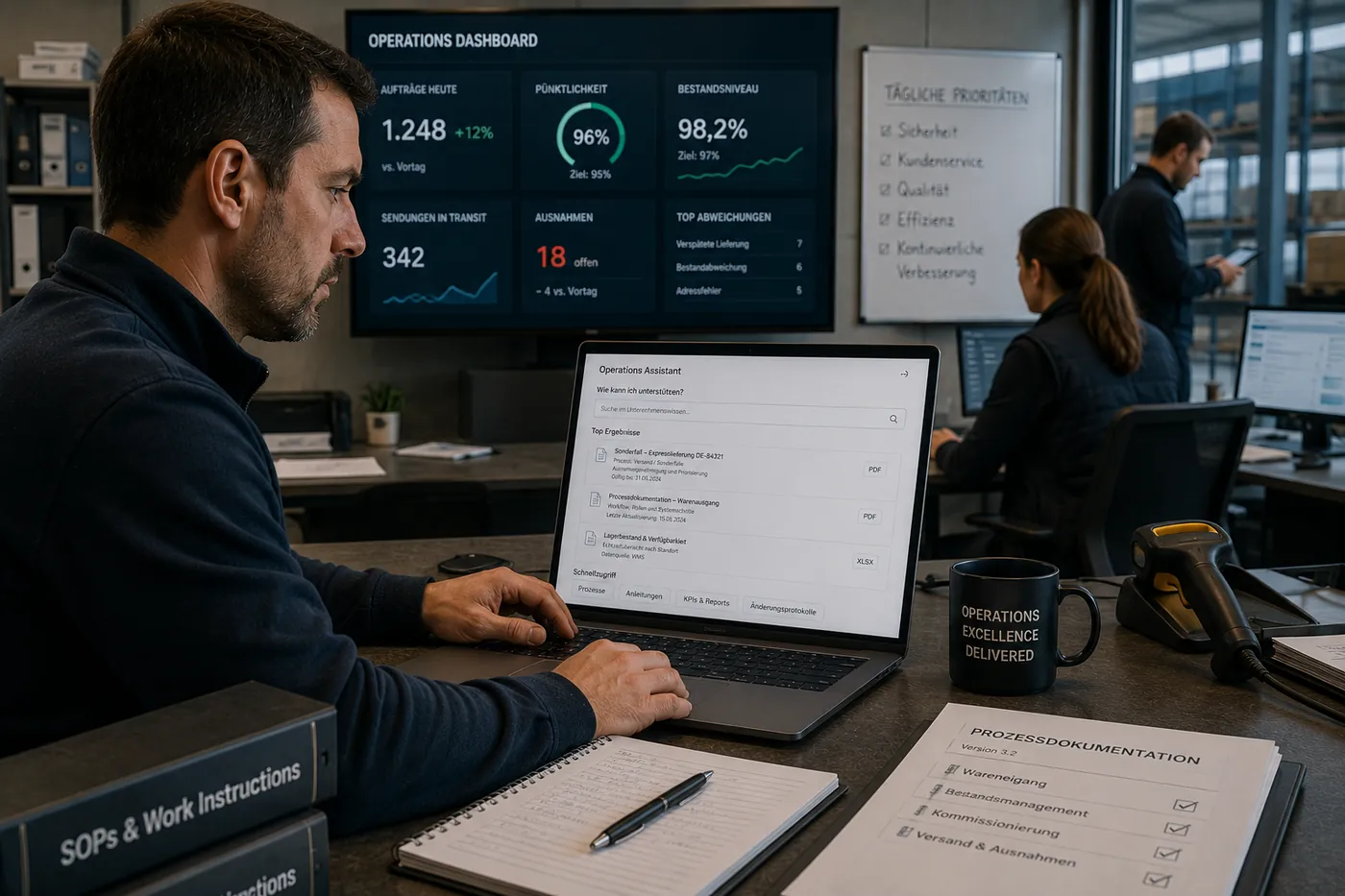
Process exceptions, escalations and decision rules are prepared in context. Teams react more quickly to disruptions and maintain standards even under time pressure.
Engineering support

Technical teams find specifications, lessons learned and documentation modules more quickly and reduce time lost in complex coordination.
Digital assistants compared to typical alternatives
Not every AI-based user interface is a productive assistant. The comparison shows which characteristics are crucial for a resilient impact in a corporate context.
Solution comparison for productive use
| criterion | Kaufman AIS | Generic chatbot | FAQ search | Copilot without knowledge architecture |
|---|---|---|---|---|
| Answers to corporate knowledge with sources | Partially | Limited to static content | Rarely consistent | |
| Role and rights model | Fully integrated | Mostly limited | No differentiated answer logic | Provider dependent |
| Process integration into workflows | Rarely | No | Partially | |
| Continuous quality monitoring | Rarely | No | Limited | |
| Scalability across multiple teams | High | Medium | Low | Medium |
Maturity levels of assistance skills
| criterion | Digital assistant | Simple FAQ list | Free corporate chat |
|---|---|---|---|
| Contextual response quality | High | Low | Swaying |
| Traceability of the statements | High | Medium | Low |
| Ability to make critical decisions | Yes, with guardrails | Restricted | Critical |
| Integration into operational workflows | No | Partially |
Security and compliance for digital assistants
Assistants often work with sensitive information. That's why we integrate security and compliance requirements into architecture, configuration and operation, instead of submitting them later as a special case.
- Access to knowledge content is role-based and according to existing authorization structures.
- Answers are logged, including the sources used, so that decisions and information remain auditable.
- Data processing is possible in European infrastructure or sovereign AI.
- Guardrails prevent the output of unauthorized content and limit responses to the intended task context.
- Technical risks are controlled via release processes, test sets and escalation paths.
- Data protection and information security are part of the operating model from the pilot to the operation.
Frequently asked questions about digital assistants
What is the difference between digital assistant and chatbot?
A chatbot often answers freely formulated questions without deep process integration. A digital assistant is geared towards specific company tasks, works on your knowledge base, takes role rights into account and is embedded in real workflows.
In which areas do companies typically start?
We often start in service, sales, internal knowledge processes or compliance-related functions, where there are many recurring inquiries and response quality directly affects customer experience, lead time or risk.
How do you ensure answers are correct?
Through source binding via retrieval, defined prompt and policy logic, technical test cases and continuous monitoring. Assistants identify uncertainty and refer to sources instead of passing off unsubstantiated statements as facts.
Can assistants also trigger actions?
Yes, in a controlled environment. In addition to answers, assistants can, for example, prepare tickets, pre-structure documents or start defined workflow steps. Critical actions remain subject to approval.
How complicated is the introduction?
It is usually possible to get started in a few weeks if there is a clear area of responsibility and a suitable database. We start with a productive core case and expand gradually.
Can existing AI tools continue to be used?
Yes. Our architecture is model and tool agnostic. Existing systems can be integrated as long as security, cost and quality requirements are met.
Is this also suitable for medium-sized companies?
Absolutely. Medium-sized teams in particular benefit from assistance functions that reduce knowledge bottlenecks and create an impact without building up a large headcount. Focused prioritization is crucial.
How do you prevent the proliferation of different assistants?
Through a clear operating model with uniform standards for data connection, prompt governance, security rules and success measurement. This means that no isolated individual assistants are created, but rather a scalable assistance portfolio.
What happens if there are changes to processes or policies?
Assistants are updated via defined maintenance and release processes. New content, changed rules and feedback from usage are continuously incorporated into the knowledge base and response logic.
When is the next step towards AI agents worthwhile?
When assistance tasks run stably and clear decision-making and approval logics are established. Then AI agents can gradually take on more responsibility in continuous process chains.
Launch digital assistants with measurable impact
In the initial consultation, we identify the assistance tasks with the greatest leverage, check data and process maturity and outline a productive introduction in your context. You will receive a clear target image for architecture, roles and implementation waves.
Contact
Tell us about a process you want to improve. We will map its data and systems, then discuss a secure first step for AI.