Internal ChatGPT for companies
Internal ChatGPT that works with your company knowledge instead of chance
An internal ChatGPT provides employees with a familiar, simple AI interface for daily questions, research and design work. The difference to public tools lies in the architecture. Content remains within your control, responses are based on verified company sources, and permissions are respected throughout. Kaufman AIS is developing this solution as a secure productive service for medium-sized and larger organizations.
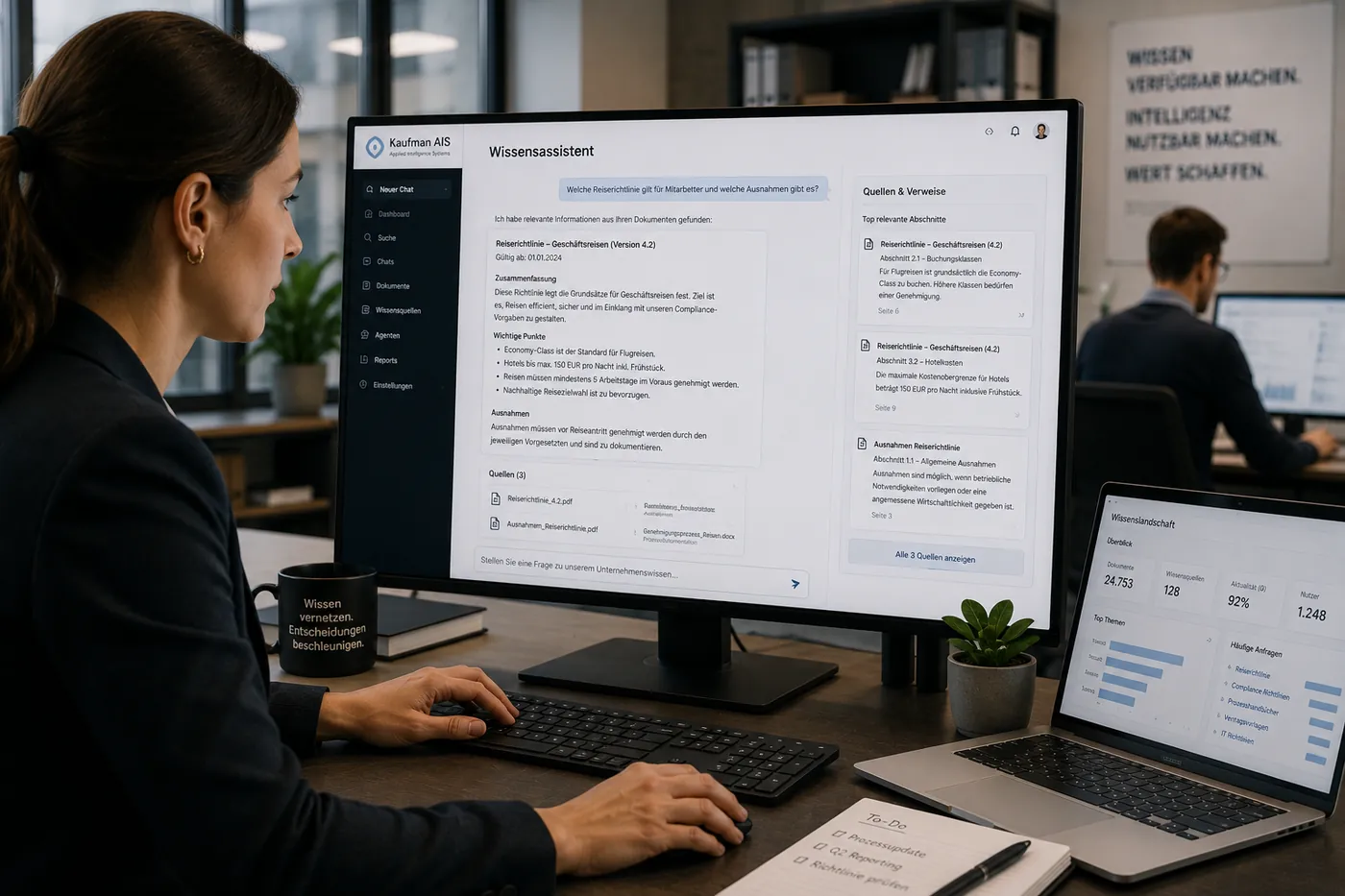
Why public AI chats are not enough for many companies
Employees are already using AI today, often regardless of central guidelines. This increases productivity in the short term, but creates significant risks in sensitive areas. Without an internal standard, shadow usage, inconsistent results and uncertainty regarding data protection, rights and traceability arise.
- Sensitive content can end up in external tools in an uncontrolled manner if no secure alternative is available.
- Answers are often not based on internal knowledge and are therefore unreliable in specialist contexts.
- A lack of role logic means that users could see information that is not intended for them.
- There is no central quality control, no governance and no clear responsibility for operations and further development.
- Teams work with different prompting habits and result qualities, which means there is a lack of standards.
- Auditing and data protection do not receive an auditable view of usage, data flows and response origins.
An internal ChatGPT closes this gap by combining the convenience of modern AI with the security and governance requirements of companies.
Kaufman AIS' internal ChatGPT solution
We deliver an enterprise-wide AI assistant that works like a modern chat, but is built on top of your knowledge and security architecture. Employees receive quick, helpful answers for everyday life, while IT, data protection and specialist departments retain the necessary control.
- Uniform chat interface for all teams with clear role rights and single sign-on.
- Source-bound answers from internal data via RAG systems instead of pure model guessing.
- Integration of relevant systems so that questions about processes, guidelines and specialist content are answered in a contextual manner.
- Prompt and policy governance for consistent response quality on critical issues.
- Operating model including monitoring, feedback and continuous development.
- Option for operation in European cloud or sovereign AI depending on security requirements.
What an internal ChatGPT improves in the company
The greatest benefit arises when employees can quickly access reliable knowledge without having to search for experts or compile rules manually each time. An internal ChatGPT shortens paths, improves consistency and creates control at the same time.
Technical structure of an internal ChatGPT
Our architectural approach cleanly separates user experience, knowledge provision, model control and governance. This means the solution remains expandable and can gradually grow from simple knowledge chat to deeply integrated AI Transformation.
Secure chat frontend
The user interface is designed for ease of use and supports SSO, role control and standardized prompt patterns. This creates a consistent user experience across teams.
Knowledge Retrieval Layer
Corporate knowledge from documents, wikis, ERP, CRM and other sources is semantically indexed and made available in context for queries. Answers are output with source references.
Model Orchestration
Depending on the application, suitable models and prompt profiles are used. Costs, latency, security level and response quality are controlled centrally.
Access and Policy Controls
Authorizations are taken from source systems, sensitive content is classified and output limits are secured by guardrails.
Logging and Quality Monitoring
Inquiries, answers and feedback are evaluated to continuously improve quality, relevance and usage value.
Integration layer for workflows
The chat can be connected to internal processes, for example for ticket templates, document templates or further process steps in specialist systems.
Fields of application for internal ChatGPT
The solution is particularly effective in areas with a high density of knowledge and many recurring questions. Visible benefits quickly arise there, without processes having to be completely rebuilt.
Employee help desk

Standard questions about IT, HR, policies and processes are answered directly. This relieves service teams and improves internal response times.
Sales support

Sales teams query product details, references, contract components and positioning directly in the chat and create consistent documents more quickly.
Compliance and policy access
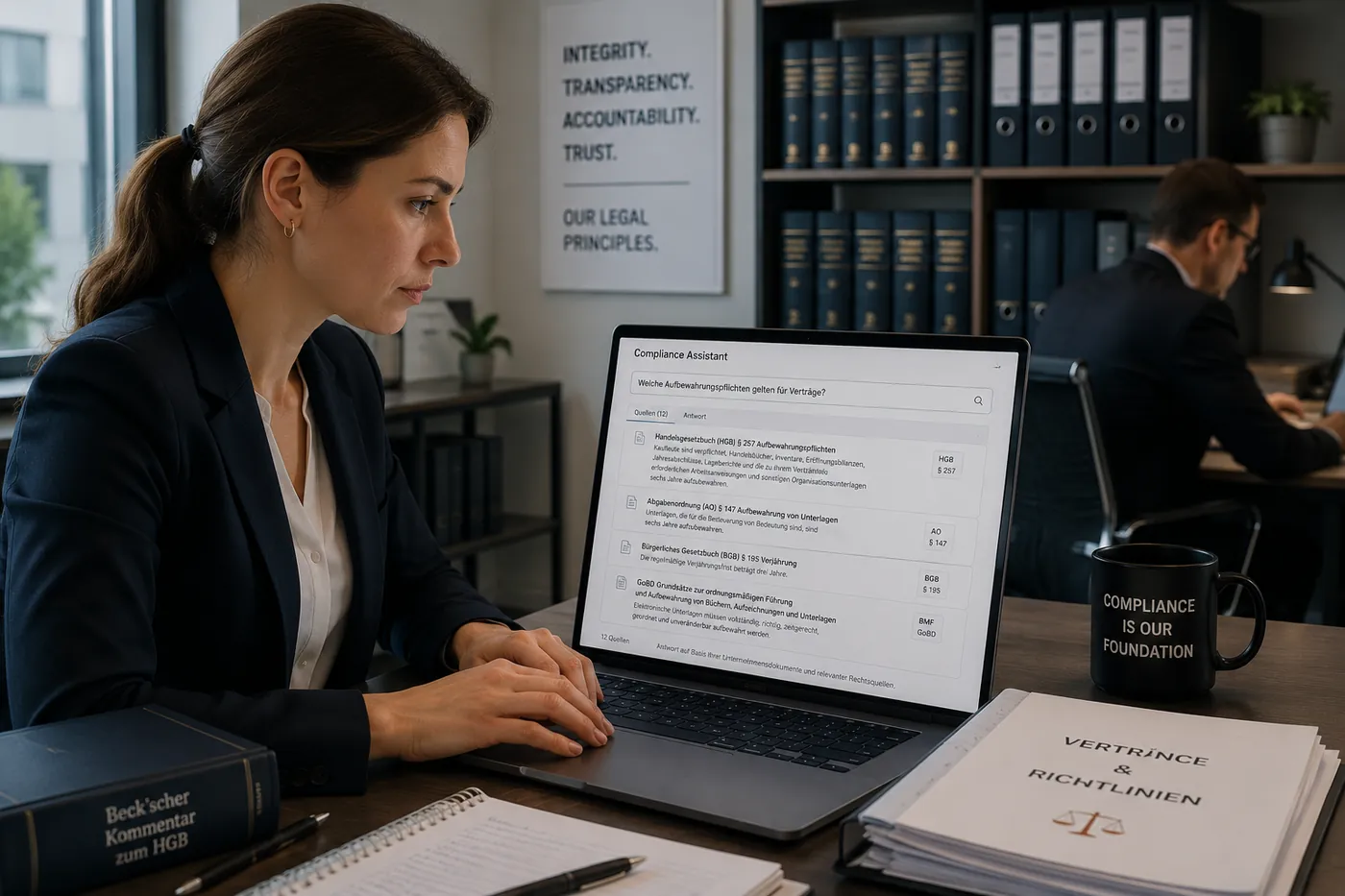
Users receive contextual answers to policy questions including sources. This reduces uncertainty in sensitive regulatory decisions.
Project and PMO support
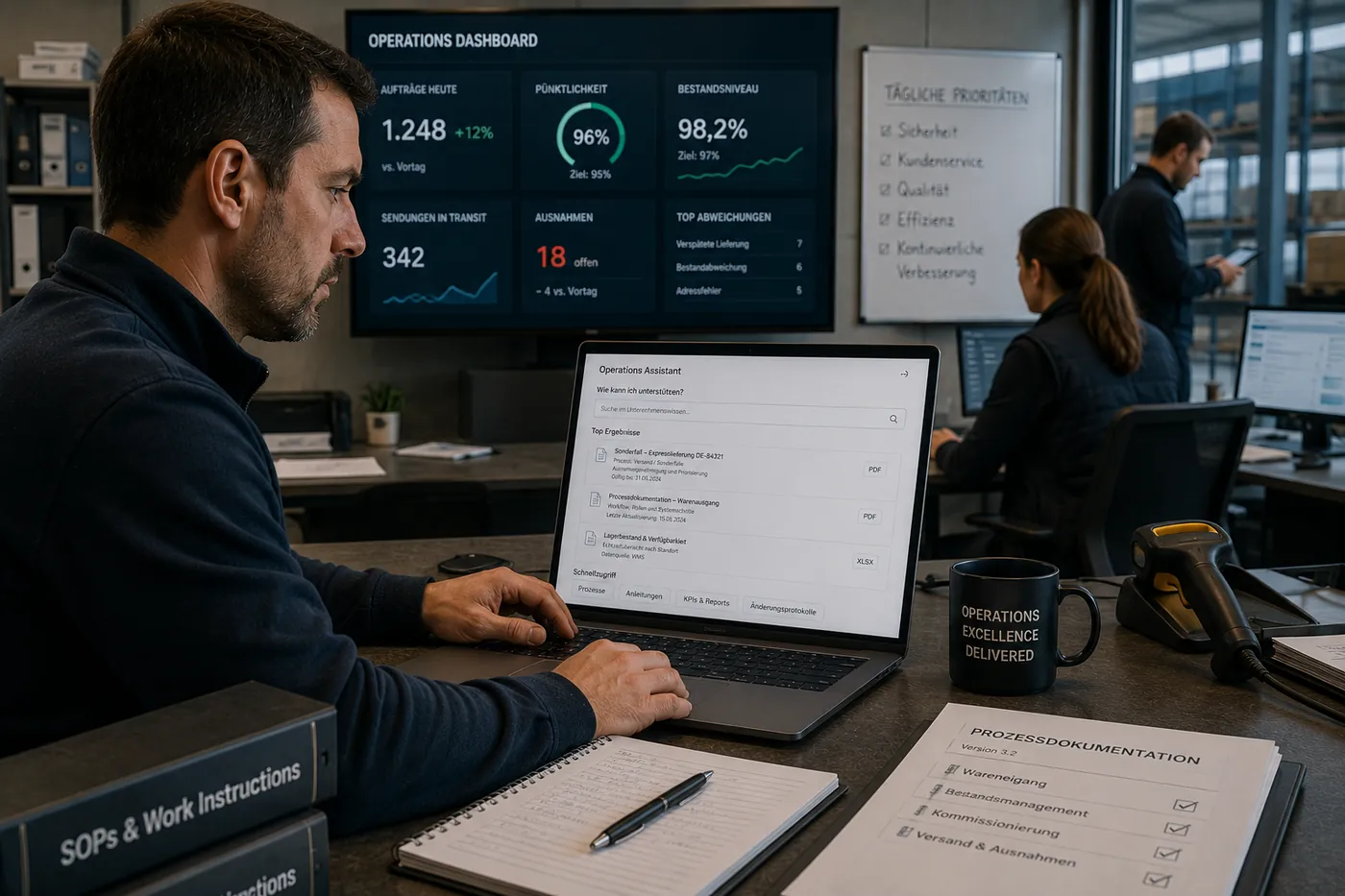
Project teams find methods, templates and status information more quickly and save time in coordination and documentation.
Access to knowledge for engineering

Technical teams efficiently research specifications, architectural decisions and lessons learned via a common knowledge interface.
Onboarding new employees
New colleagues receive immediate access to relevant company knowledge and reduce the start-up time in the team.
Internal ChatGPT compared to alternatives
The term ChatGPT is often used for very different solutions. The comparison shows why an in-house approach offers clear advantages in security, quality and scalability.
Comparison of chat approaches
| criterion | Kaufman AIS | AI public chat | Simple intranet chatbot | Uncoordinated tool usage |
|---|---|---|---|---|
| Use of internal knowledge sources | Yes, source bound | Restricted | Partially | Inconsistent |
| Role and rights control | Mostly no | Limited | No | |
| Auditability and governance | Complete | Low | Partially | Not given |
| Suitability for sensitive data | High | Critical | Medium | Critical |
| Scalability across teams | High | Medium | Low | Low |
Maturity level and strategic benefit
| criterion | Internal ChatGPT | Free team chat with AI | Document search without AI |
|---|---|---|---|
| Response speed | High | Medium | Low |
| Consistency across departments | High | Low | Low |
| Controllability of risk and costs | High | Low | Medium |
| Basis for further automation | Limited | No |
Data protection, security and operational control
The security architecture determines long-term success, especially when used company-wide. We rely on a model that enables usability and governance at the same time.
- Role-based access with inheritance from existing identity and rights systems.
- Encryption and controlled data paths for request, context and response.
- Audit logs for usage, sources and configurations as a basis for auditing and data protection.
- Guardrails against unwanted data output and for defined response limits.
- Optional separation according to protection classes so that sensitive areas run in separate infrastructure.
- Compliance-compliant operation in EU environments or on-premise depending on requirements.
Frequently asked questions about internal ChatGPT
Is an internal ChatGPT just a renamed chatbot?
No. An internal ChatGPT is a company-wide AI application with knowledge connection, role rights, governance and operating model. It goes well beyond a simple chatbot because it can be integrated into real company processes.
How do the answers from public AI tools differ?
The answers are based on your internal knowledge base and can be verified with sources. This increases technical reliability, especially for company-specific questions that public models cannot answer without context.
Can sensitive data be processed securely?
Yes, if the architecture is designed accordingly. We rely on role-based access, encryption, auditing and, if desired, sovereign operating models in European or our own infrastructure.
How quickly can you start?
A first productive use is often possible in a few weeks if the use case and data sources are clearly prioritized. We start with a focused scope and gradually expand the solution.
Does this require the entire system landscape to be rebuilt?
No. We integrate existing systems via connectors and APIs. The goal is a pragmatic structure with a quick impact and long-term expandability.
How are hallucinations reduced?
Through source-linked retrieval, clear response logic, guardrails and continuous quality monitoring. The chat characterizes uncertainty and refers to evidence instead of presenting unsubstantiated statements as facts.
Which teams should be involved first?
Areas with a high frequency of inquiries and clear knowledge patterns, such as service, sales, internal services or compliance-related functions, make sense. The benefits can be quickly measured there.
Can we build digital assistants or agents on top of it later?
Yes, that is a key advantage. The internal ChatGPT can serve as an entry-level interface and later transition into digital assistants as well as further agent skills.
How is the system content prevented from becoming outdated?
About automated synchronization of sources, clear data owner responsibility and regular quality cycles. Expert feedback from use flows directly into further development.
Is this also realistic for medium-sized companies?
Yes. Medium-sized organizations in particular benefit from faster access to knowledge and standardized AI use. The start is focused and does not have to be a large project.
Assess AI opportunity in 3 minutes
A short check of systems, friction points, and goals shows where enterprise AI can create measurable impact first.
Internal ChatGPT as a secure AI basis for your company
In the initial consultation, we analyze your requirements for data protection, knowledge access and user groups and design a productive introduction to an internal ChatGPT. You will receive a clear picture of the architecture, effort and the quickest levers for measurable benefits.
Kpekpeɖeŋu
Ɣe nu si wòdi be yewoatrɔ la gblɔ na mí. Míakpɔ eƒe data kple sistɛmwo, eye míakpe ɖe wò ŋu atsɔ AI azã le mɔ si le dedie dzi.